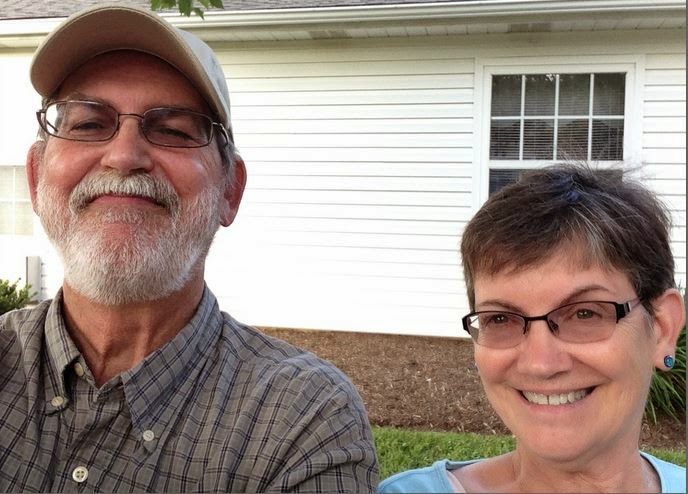
Scripture readings for worship today (February 25, 2024) included the story of Abraham and Sarah. Those who were in worship with me on a similar Sunday in 1980 let me know today that they still recall the big laugh that happened that day, as our new mission start congregation met in the local funeral home. From my Parson Ponders column which followed in 1980. BTW, it was "Bub", not "brother."
Sunday, February 25, 2024
A God Who Chuckles
Friday, April 2, 2021
Over my lifetime, Good Friday has come to mean to me the piercing, bleeding, sobbing realization that we are (I am) incapable of (and even, at times, flaunting of) the life of peace, beauty, love, and harmony that we (I) say we (I) want in better and higher moments. We are broken and cannot put the pieces back together again. We have given in to hopelessness and accepted the status quo.
Over my lifetime, Good Friday has come to mean to me the promise of rich, red rivulets oozing from a thorn pierced scalp, snaking their way over pain creased forehead, filling a brow to overflowing, before spattering on the freshly disturbed sand below, each droplet asking me {us} to let the truth sink in that this is love: unstoppable, freely given, all-powerful love …. Given and shed for you (me).
Over my lifetime, I have begun to come to the understanding that Good Friday is an invitation to love and forgiveness, for me, and for you, for every friend and foe, for those who drove the spikes home on that dark day, and for all those whose broken, hurtful lives are laid out before us in the news each day.
Thank you, lovely, bleeding, dripping, pouring, Jesus. May your unyielding, freeing love help us to begin to pick up the pieces, to live with ourselves, to live better and more hopefully with those we love, and to begin helping to put some of the broken pieces of this fractured world together again.
Monday, October 26, 2020
The Parson Ponders: Subdued Light
As I began my morning rounds today, testing out how well my neuropathy compromised feet were going to cooperate today, I became transfixed by this old maple tree. Today, in the subdued light, it practically glows. Isn't it strange that, in the subdued light, you can see more of it, including the interior of the tree, better than when the sun shines brightly? In full sunlight, we can easily see the most prominent leaves, but they cast shadows that obscure the inside of the tree. But on this gray, rainy day, there are no shadows. All parts are equally illumined. As I turned around and walked to the mailbox to fetch the newspaper, I wondered: perhaps dark and gray times such as we are going through now help us to see our world more clearly, what is most important, what we truly cherish, who we have ignored, who and what has been hidden in the shadows. Gospel stories of loving one another and caring for the hurting make more sense. I still love the sunshine, but I can learn a lot from the overcast times and grow in its subdued light.
Wednesday, April 8, 2020
Good Friday Pansies
My friend, Jean, is using her home time to go through her "saved clippings" file. She just sent me this one, my Parson Ponders column from 1997. That was the year my mother died on Good Friday. It's Good Friday again, and it is a day that is still about death .. and life.
The Parson Ponders: Good Friday Pansies
Something very strange happens when someone we love dies. As soon as the death occurs, we begin counting up all the reasons why we should be thankful, in spite of the blackness of the moment. It's our way of holding back death, keeping it at bay, caging it in so that it can't go any farther than it has already gone.
We begin trying to chip away at it, bringing it down to a more manageable size. Like Paul, we're reluctant to concede that death has won: "Where, O death, is your victory? Where, O death, is your sting?" (1 Cor15:55 NRSV)
I'm becoming more of an expert than I wanted to be on this count since my mother, Norma, died suddenly on Good Friday. She hadn't told us of any health problems, and in fact, she got the turkey out to thaw and was planning to spend Good Friday planting pansies in the planters around her patio pond to brighten the family's Easter celebration. She surely knew how to make a festive occasion.
As she sat on the couch after breakfast and planned out her day, a massive stroke ushered her out of this life and into the next.
Though the emergency squad arrived at the house in only minutes, and though the hospital kept the body alive with the aid of a respirator for a few hours until the family assembled, my mother actually died quickly there on the couch. As the breathing tube was removed and we watched the very quiet and peaceful closing of an earthly life, already an easter celebration was trying to erupt and break through the darkness. Already we were beginning to give thanks. Already we were beginning to chip away at the power of death.
There was -- there is -- so much to be thankful for: almost 80 years of a full, robust life with very little sickness and doctoring, almost no suffering, a quick and peaceful passing, 57 years of marriage with my father, 3 good kids who cherish family and God and make a contribution to the world around them, loving daughters-in-law and grandkids who this grammy couldn't stop talking about.
My mother was a generous caregiver for her parents and brothers and sister and their extended families. She had a strong faith and was a leader and organizer of several ministries in our home congregation. One of the most touching acts of kindness after her death was the pots of azaleas sent by 30 or so of the flock who had been part of the church youth group a number of years ago when my mother and father served as youth sponsors. And she had a way with flowers. People driving by my parents' home would often stop in to ask if they could look at the flowers growing in the yard.
Even though we put up a valiant front at chipping away at death, we're not very good at it. We feel a lot like the people of Grand Forks, North Dakota trying to build up our sandbags to hold the flood back, knowing that the flood is too big and powerful.
But in the end, we don't really have to be very good chippers. As Paul says: "But thanks be to God, who gives us the victory through our Lord Jesus Christ." 1 Cor 15:57 What wonderful news to hear the victory cry again on Easter morning that "He is Risen" after the blackness of Good Friday.
We're still doing our part. We're still chipping away. On Holy Saturday, we planted my mother's pansies for her. And every day, we recall more things for which to give thanks. But mostly, we're just clinging to the good news of Easter that "He is risen" and that he has gone ahead to prepare a place for us.
Monday, January 13, 2020
Who's sitting in the corner?
I've been on a search for this picture, now found, for months. I enlisted daughter Amanda in the search too. And after several weeks, she found it!
I don't know why I became so fixated on it. It only serves to make me look foolish, but then, maybe it's good to have a reality check from time to time.
The picture was snapped in 2003 when our family was on our first-ever California vacation. We were in the Sonoma Valley, touring wineries and sampling their wines.
At Foppiano Vineyards, I let the rest of the gang go up to the sampling bar, and I hung around back. I was driving.
That's when I noticed this old codger, sitting alone in a chair in a corner in the back. I felt a little sorry for him. To me, he looked kind of lonely and out of place. So, jumping to conclusions, I thought I would do him a favor and strike up a conversation. We pastors usually know how to do that. I gave him my very best pastor chit-chat. Wasn't that nice of me to do that.
Eventually, I asked him what he did for a living before he retired. He said, "Did you ever hear of something called Continental Airlines?" "Sure, " I said. He came back, "Well, I helped found it." Whoa....What? ... Reality-check!!! I surely underestimated this man!
Since that moment, my research tells me that this man, Louis J Foppiano, was indeed best friends with the man usually credited with starting Continental Airlines. What he didn't mention that day was that, when he was 14 years old, his father died, and from that time on, he and his mother managed and grew the Foppiano Winery. He continued to oversee the winery into his nineties. He died in 2012 at age 101. He was afforded much acclaim at his passing.
We did wise up enough to ask if we could have a picture with him. He was very gracious. I haven't been that off base on someone since the time, early in my ministry, when I spent 15 minutes chatting with an "ordinary" man without realizing I was talking with the president of General Motors.
No, I take it back. I'm sure I have missed the mark most by missing the treasure of the truly ordinary people we meet every day who are really the greatest treasures in disguise, people like Jesus noted: the widow adding her 2 coins in the treasury box, or the children trying to make their way to Jesus. I am thankful whenever Jesus gives me new eyes! Treasures abound!
Monday, November 19, 2018
Forecast: CLOUDY
| CLOUDY! |
When I think of November, I hear Gordon Lightfoot singing about "The Wreck of the Edmund Fitzgerald" "when the skies of November turn gloomy."
And when I think of November, I think of clouds, gray clouds, pervasive clouds, clouds that are like a ceiling ever lowering on me, ushering in my first taste of it getting dark before it's time for supper.
Yup, you can always count on your pondering parson to lift your spirits! Before you simply sign your name to this article and leave it for your suicide note, let me make a stab at lifting my spirits and yours.
Let's talk about clouds.
Even though clouds are "downers" for us, clouds are often painted as "uppers" in the Bible. It was a cloud that God used to lead the people in the wilderness. "The LORD went in front of them in a pillar of cloud by day, to lead them along the way," Exodus 13:21
The Lord's presence is often signified by a cloud: "And as Aaron spoke to the whole congregation of the Israelites, they looked toward the wilderness, and the glory of the LORD appeared in the cloud." Exodus 16:10
Moses met God in a cloud on Mt. Sinai: "The glory of the LORD settled on Mount Sinai, and the cloud covered it for six days; on the seventh day he called to Moses out of the cloud." Exodus 24:16
God often speaks in a cloud: "Then the LORD came down in the cloud and spoke to him, and took some of the spirit that was on him and put it on the seventy elders;" Numbers 11:25
Nor should we forget that glorious experience Jesus and the disciples had on the mountain of the transfiguration: "While he was still speaking, suddenly a bright cloud overshadowed them, and from the cloud a voice said, 'This is my Son, the Beloved; with him I am well pleased; listen to him!'" Matthew 17:5
And remember how Jesus left our earth? "When he had said this, as they were watching, he was lifted up, and a cloud took him out of their sight." Acts 1:9
Jesus even told us that a cloud would figure in his return: "Then they will see 'the Son of Man coming in a cloud' with power and great glory." Luke 21:27
But the very best cloud to think about in November is the one that is mentioned in Hebrews 12:1 "Therefore, since we are surrounded by so great a cloud of witnesses, let us also lay aside every weight and the sin that clings so closely, and let us run with perseverance the race that is set before us,"
On All Saints Sunday, we remembered the great cloud of witnesses that surround us.
It's November again. It's CLOUDY! Seems like the clouds have just settled in and engulfed us. Clouds are a good thing to give thanks for come Thanksgiving too. I'm guessing that at most Thanksgiving tables, with the family gathered around for the annual feast, we can't help but think about all those who have shared this meal with us in the past who are now in a different realm. They are part of that great cloud of witnesses and they are cheering for us to "run with perseverance the race that is set before us,"
God is good, even when, especially when, it is cloudy.
Monday, December 18, 2017
Is This How You Come To Us, Jesus?
A few years ago, lying in bed, sleep subsiding and yet not quite awake, a simple tune began burrowing into my consciousness. It played.... and it played again. And again.
Next day and the next, same thing. Strange! And it persisted.
After a time, I could hum the tune when I woke up. I decided to see if I could hum it and add some guitar chords. The chords presented themselves in a matter of minutes.
Eventually, in my waking slumber, I began putting words to the tune. They rolled out quickly as well.
So the song emerged. I sang it that Christmas Eve.
I've decided to post a recording of it I made with my daughter Amanda. A little scary to post a home made song when you're not a song writer, and it's not hard to see where the presentation could improve, but I must say, I do like the message. The words connect what happened in Bethlehem with what happens with us. It talks about Jesus intertwining his life with ours. It testifies that we often see Jesus most clearly in the dark moments and in the humble moments in our lives. And it affirms that Christmas is all about God's love for us!
We have been through some very dark and humbling moments this year, just the kinds of times when we can expect to see Jesus and his surprising love for us.
"Is This How You Come To Us, Jesus?"
Words and music by Pastor Tim Keeler
Stable light,
Glowing light,
Darkest night
Angel flight
Manger bed,
Cows were fed,
Cradled head,
Love was said.
In a stable musty
A child, a shepherd must see,
Joseph came, he did not flee,
Mary answered, "Let it be."
Is this how you come to us, Jesus?
Is this how our lives intertwine?
In dark and humble moments
Your love begins to shine.
Shepherds doing what they do,
Passing time without a clue,
Soon to learn that all is new,
Angels grace the scruffy few.
Now we sense this gleaning:
Our God, who gives all meaning,
From heav'n to earth is leaning,
In flesh, intervening.
Is this how you come to us, Jesus?
Is this how our lives intertwine?
In dark and humble moments
Your love begins to shine.
We welcome you here blessed Jesus.
We welcome you into our lives.
Like shepherds and Joseph and Mary,
We welcome your surprise.
Gloria in excelsis!
Sunday, October 8, 2017
Make A Leaf?
Could you make a leaf for me?
One leaf. That’s all I ask.
Just one green or yellow or red leaf. Let’s say...a maple leaf.
I don’t mean that I want you to draw a leaf for me. I don’t want you to make one out of clay or fabric or wood. Don’t bother tracing one on construction paper.
I wonder if you could make just one of those feathery, manufacturing dynamos that are falling in the billions around us right now. It shouldn’t be hard. There are bushels full of them just outside your door for you to study.
If you feel up to it, try making one that:
-has a giant sun collector panel on it, one that can automatically turn itself towards the sun,
-has a big bunch of little tubes --microscopic tubes-- running through it in an intricate branching system
-can appear all by itself at just the right time in spring,
-can attach itself to a limb on a tree,
-is strong enough to withstand pelting rain, windstorms and droughts,
-can spend 6 or 7 months cooking up good food to send to the tree,
-is equipped with little breather holes to take bad things out of the air and replace those bad things with purified, oxygen laden air.
And if you don’t mind, when this single leaf has weathered wind, hail, rain and scorching sun through spring and summer and has come to the end of its life, could you make it have one last hurrah? Could you send it off in a blaze of colorful glory intense enough and beautiful enough to inspire poets and photographers and even little children?
God must have a hearty laugh every fall when the leaves let loose and take flight. We can’t make even 1 leaf. One single leaf outstrips all of our technology. But God makes zillions of them every year----and then lets the work of his hands rain down upon us in a blizzard of color. These intricate machines --- manufacturing plants that give the tree what it needs to soar scores of feet into the air, and to build trunks and branches that can live hundreds of years --- are tossed to the ground to give all their intricacies back to the earth.
The creator jettisons every last one of these miracles of his hand, tossing them to the wind, knowing that he can do it all over again come spring.
Yes, there are terrorists, snipers, disease, hurricanes and war around these days..
They seem very powerful, but if you’ll pick up a leaf, you’ll know who is really in control and that, in the end, all will be well.
Saturday, December 3, 2016
Wrinkles
She was unknown to me, but she was there at the funeral home with some of the other family members I had come to visit. My eye gravitated to her as soon as I entered the room. She was an older woman who had a very expressive face. Deep furrows mapped out lines in her cheeks and around her eyes. She was, in a word, "wrinkly" ---- if that's a word.
Now I don't mind wrinkles. I think they are testimonies to a full life, the marks of wisdom and a well seasoned life. Smooth faces are kind of like a new pair of jeans that haven't been broken in yet. But wrinkled faces are one-of-a-kind treasures. They are like the rich patina on a piece of antique furniture that can't be duplicated on a piece of wood by a quick application of stain. Wrinkles take time to make, like the slow changing of copper from its bright shiny glow to the greenish sheen it takes on over a period of years that says "this has stood the test of time."
So, I noticed this woman's wrinkles, but something didn't seem right about them. Of course, it's not every day that I spend a great deal of time pondering someone else's wrinkles, especially when they belong to a person to whom I have just been introduced. Still, there was no denying it. Even to the recently introduced pastor, there was something peculiar about these wrinkles. But what was it?
Just then, my friend offered insight into this wrinkly faced woman: "She really is a wonderful and happy person!" With that, I saw that face completely rearrange itself. The woman broke into a broad smile. Instant transformation! Then I knew what was wrong before: the woman wasn't smiling. That's what made those wrinkles seem unnatural. When she smiled, every fold of skin, every grooved line, seemed to snap to attention. Every surface line conformed itself perfectly with the muscles underneath. Every groove and muscle became one with the true spirit of that woman. This is who she is. She is a smiling person. That's what she spends most of her time doing. Her wrinkles are marks of her happiness and her true nature.
In Advent, we spend a lot of time thinking about wrinkles and grooves and ruts and straight paths. John the Baptist steps onto the stage with words like, "Prepare the way of the Lord, make his paths straight." (Matthew 3:3)
This advent, I'm going to spend some time preparing by thinking of that woman and her wrinkly face. When she grew into that smile, she aligned her face, her grooves, her muscles, and her spirit with God's purpose for her in life: to smile. She was doing what she does best. The wrinkles got their kinks out and made straight paths in her face that seemed to go straight into the very heart of her being.
It is a beautiful sight when our wrinkles get lined up with what God wants us to be. During Advent, may we be open to God's love and inspiration, and may our wrinkles be signs that the Christ child has made his home in our lives.
Thursday, September 8, 2016
My Little Red Knife
I didn't know that I needed a little red knife when, more than a decade ago,
Martha's brother Frank presented one to me and one to all the family members
one Christmas. I had been ignorantly sailing through life with a pocket that
was devoid of one of the most crucial items anyone could every carry.
And I didn't know it.
Now, if I reach down into my pocket and I don't feel that knife's familiar smooth side and ridges, panic sweeps over me. Did I lose it? Is it gone forever? Where could it be? Where did I have it last?
My little red knife is multi-faceted. There is, of course, a knife blade.
Then's there's the nail file which sometimes can double as a screw driver or
pry bar. I particularly enjoy the mini-scissors. When my wife is forcefully
asserting to me that someone stole her scissors (a rather uncomfortable
experience for me now that the kids are out of the house) I can at least whip
my little scissors out and offer them to her (while I'm trying to think where
I last had her scissors!). My knife's tools are nicely rounded out with a
toothpick (cleanliness not guaranteed), and a small but effective pair of
tweezers.
Just in the last few months I have used my little red knife to open packages
and letters, cut my fishing line, peel an apple, cut pictures out of the
newspaper, dig splinters out of my finger, loosen a screw, saw through weeds
rapped around my rototiller, harvest broccoli in the garden and remove
something stuck between my teeth (it was an emergency--no time for
cleanliness!)
I even lent it to my brother one day recently when we ran out of minnows on
one of our crappie quests. He used it to dissect a fish, the dissected parts
to be used for bait so that we would have something to present to the
especially ravenous crappies that day. On the habitat trip, I performed
surgery on the hand of the local construction committee chairperson who's
finger had become home to what was supposed to be a part of the house. My
tweezers grabbed that little sliver and restored his bliss. They grabbed
several slivers that week as well as being used to reform ragged fingernails
torn in the construction process.
People depend upon me. They depend upon me having my little red knife handy
at all times. It has become a part of me. My self image would suffer without
it. And before it was given to me, I didn't even know I needed it.
My little red knife is a lot like faith. A lot of people don't know they need
it, but when someone gives it to them, they soon can't figure out how they
ever got along without it. They begin to carry Jesus' word's and promises
with them all the time. They're continually reaching into their pocket or
their heart for it. They find that they depend upon it, and others depend
upon them having it.
I want you to know that my little red knife, like my faith, is in my pocket,
giving me confidence, ready for action at all times. I can't imagine how I
would get along without either one of them.
Wednesday, September 7, 2016
The Parson Ponders: Offering Plates
I've seen all kinds of them...brass, silver, aluminum, wooden. I guess you can make an offering plate out of just about anything. The fact is, I've discovered that when people want to give they can always find something in which to collect the offering.
Through the years, I have placed my offerings in hats, buckets, wicker baskets, china bowls, styrofoam cups, and paper bags.
I've seen five gallon water jugs fill with coins to support youth group trips.
It seems clear that if you give people opportunity to make an offering, they
will. Something yearns within us until we share from our bounty.
As a child on a fishing vacation in Quebec, we attended a French speaking
Catholic church on a Sunday morning. I couldn't understand the lessons nor
the sermon spoken in French; nor could I understand the liturgy sung in Latin.
But I did understand when the usher came around with what looked like my dad's
landing net. He inserted that pole into our row, and passed the pouch on the
end of it to each one the row's occupants. We may not have understood
anything else in the service, but we understood the offering.
At one mass worship service I attended, the offering was collected in Kentucky
Fried Chicken buckets. There's something strange about having Colonel Sanders
smiling approvingly at you as you drop your money into the bucket. But then,
maybe that's not such a bad idea. Perhaps it would be good to have a smiling
Jesus on the side of our offering plates...or smiling children...or smiling
hungry people...or thankful senior citizens.
In the old testament people felt the urge to make offerings too. They made
offerings for a variety of reasons. Some felt guilty, and the offering helped
ease their conscience. Some wished to honor another person, and they gave an
offering to God in tribute to the person. Some gave an offering as they asked
for God's favor.
But mostly, they made offerings out of thanksgiving for the generosity of
their creator who gave them all that they had. God created their world. God
created them with all of their talents and abilities. They offered their
"first fruits" as a sign that the first and the best of what they had belonged
to God.
In the New Testament, Jesus admired the widow who felt the urge to give to the
poor even though she herself was nearly penniless. And since there was an
offering box for the poor outside the temple, this widow who felt blessed in
spite of her lack of funds dropped in her two coins, all that she had.
Even children understand the offering plates. They love to bring their
offering and have the privilege of putting their quarter in the plate as it
goes by. Sometimes Dad even lets them take hold of the plate and pass it
themselves in spite of the ever present danger of the slipped plate dropping
and banging to the floor and coins rolling to who knows where under the pew.
But then, as I have observed, even sure handed ushers occasionally lose
their grip on the full plate!
The offering plates aren't just about money. They are about a deep seated
need within us to acknowledge the one who made us out of nothing. Whether the
offering receptacles are made of fine polished brass or a cardboard chicken
holder, we will use whatever is at hand to offer up a portion of what has been
given to us.
Friday, October 16, 2015
The Back of the Head
October 11, 2015 - I attended worship at David
Lutheran Church
in Canal Winchester
last Sunday. I sat directly behind an older man. The back of his head
captivated me. I couldn’t think who might be on the other side of that head,
but that head posterior sure looked familiar. When he turned around during the
passing of the peace, I instantly recognized him: “Hap!” Yes, it WAS a head I’d
seen before: Pastor Hap Hasenhauer. I hadn’t seen him in over a decade, and
that was when he served in Bucyrus and I in Galion, but once you’ve seen the
back of a head, I guess it sticks with you. It reminded me of this Parson
Ponders that I wrote in 2002.
I was sitting in my pew at a clergy conference. We were at worship. My thoughts were directed towards the
goodness of God’s love and mercy. But
then I saw the back of that head. It was 3 or 4 rows ahead of me. I said, “I’ve seen the back of that head
before. It looks like the head of that
pastor who I used to know but haven’t seen for probably 20 years.” I kept studying the back of the head of that
pastor. I’ll call him Pastor “Long-ago.”
I kept wondering. I
said, “I don’t ever remember studying the back of Pastor Long-ago’s head, but
when I see it, I instantly know, or think I know that it is him, even though I
haven’t seen him for two decades. How
very strange.”
A little later in the service, it was time for the passing
of the peace. I saw him turn around to
pass the peace with those around him. I
saw his face. “Nope,” I said, “I was
wrong. It’s not Pastor Long-ago. It doesn’t look like him.”
Still when he sat down again, and I was again confronted
with the back of that head, I was struck anew by its familiarity. It wasn’t until we got done with worship and
got to our coffee and cookies that the riddle was answered. As I strolled along munching a chocolate chip
delight, a voice called out, “Well, it’s Tim Keeler!” You guessed it. It was Pastor Long-ago. A face can change quite a lot in 20 years, I
discovered. But the back of the head,
that’s another story.
We often say, “I know this or that like the back of my
hand,” but it must also be true that we know people like the back of their
head. I've been studying the backs of heads ever since. I find that I know lots of people by the back
of their head.
There are some important faith things we know that we often
don't realize we know. When Jesus told
the disciples that he was going to prepare a place for them, and that he would
come back and take them to that place, he ended with these words: "And you know the way to the place where
I am going." (John 14:4) Thomas
didn't know that he knew the way to where Jesus was going. He questioned: "Lord, we do not know
where you are going. How can we know the way?"
Jesus said to him, "I am the way, and the truth, and
the life. No one comes to the Father except through me."
I have a feeling that just like we know more about the backs
of people's heads than we think we know, all of us know more about faith than
we think we know. We trip ourselves up.
We forget that we know about these things. We get bogged down with trivial questions
that block us from seeing the important truth that we already know.
Jesus said to him, "I am the way, and the truth, and
the life. No one comes to the Father except through me." We know that.
We may not know every single answer to every extraneous question, but we
know that Jesus is the way, the truth, and the life. We know that our hope lies not in what we
know but whom we know.
Take a look at the back of a few heads this week. I'll bet you'll be surprised at how many
times you will be able to identify folks by the back of their head. You know more about them than you think you
know.
And I'll bet you know more about your savior than you think
you know. Whatever you don't know about
him, you know that he is the way, the truth and the life.
Friday, April 17, 2015
The Creaking Toe
I have a problem. It's my toe. It creaks. At least I think that's what
it does. I mean, saying that it squeaks doesn't seem right, and saying that
it cracks sounds like I should be headed for the emergency room. Whatever the
right word for it is, my toe still makes funny noises when I walk. I don't
know why. It just does. Seems like it always has.
Most of the time I never notice or remember that I have a creaking toe.
When I'm walking around in the garage sweeping or nailing boards together I
never hear my toe creak. When I'm walking uptown amid the noise of cars and
the wind, it's like my toe is the quietest piece of machinery anyone could
hope to own. It's primarily when I'm "working" that I hear the "creak,
creak." Do you know how quiet it can be walking down a hospital corridor? Do
you know how a creaking toe can sound like a screaming siren when you're
creaking away down a hallway? Inevitably, the person I am visiting is in the
last room off the hallway, and I must creak past dozens of patients, nurses
and doctors who all must be saying to themselves, "What's that creaking
noise?"
There was a time when I was very embarrassed by this. I tried walking
stiff legged. I tried arching my toe inside my shoe while I walked. I tried
taking short steps so that my toe wouldn't bend so far. Nothing worked. I
even thought this might be a sign from the Lord that I shouldn't be a pastor.
After all, if I were a contruction worker, no one would ever know about my
creaking toe; but as a pastor, with the quietest of things to walk into--like
worship and funerals and marriage services -- oh my, disaster.
But then I thought of Moses, whose speech problem made him suggest to God that
he would make a very poor spokesman for God. What if he would have become a
construction worker? And Paul wrote of the "thorn in his flesh" that
indicated a physical problem he had, possibly epilepsy. In 2 Corinthians 12
Paul says: "Three times I prayed to the Lord about this and asked him to take
it away. But his answer was: 'My grace is all you need, for my power is
greatest when you are weak.'"
I don't feel embarrassed by my creaking toe any longer, for it is at those
times when I am feeling the weakest -- when I speak for God to a person who is
facing a serious illness or a group of people trying to cope with the loss of
a loved one--that I hear the creak of my toe. That creak is a reminder from
God, "My grace is all you need, for my power is greatest when you are weak."
Thursday, September 11, 2014
Bill has the last laugh
Let it be known:
Bill had a great last laugh …… even if it was at my expense. My brother Bill
died on August 13th from a fall, or a stroke, or both, but several
weeks before that, he let out a carefree, unrestrained, straight from the soul
laugh that did him and all of us good.
Still, the dementia
was relentless, gnawing away at the realities of the present, making Bill’s
smiles fewer and further between. There was a somber, far away look in Bill’s
eyes that summer evening as we sat with him on the patio.
That’s when I
happened to glance down at my pants. There on my lap was a big white bird
splotch! I quickly went into feigned catastrophe mode: “I’ve been hit!” “Some
bird has got me!” “Quick, a napkin, a Kleenex, a towel!” My trusty partners
sprang into motion looking for something to dab up the bird poop. Bill tuned in
and began to smile.
But it wasn’t
done. Just as I reached for the scavenged Kleenex, another plop! This time, the
bird dew landed on my shirt sleeve!
This is too much
for Bill. Whatever dark cloud had been hovering over his consciousness quickly
lifted. Bill let out a genuine happy, “Ha!!!” It was the Bill of old present
among us. It was a real treat! Pretty funny that it took a dive bomber bird to
break through the evil spell upon him. What a joy it was to see.
Now that Bill has
transitioned to God’s place, where there is no such thing as dementia, I keep
thinking about those bird splotches and Bill’s last laugh. It doesn’t take much
pondering of the story of Jesus and the promises of scripture to get God’s
picture. Like a splotch on my pants, God’s love and promises land on me, not to
be ignored. And as I realize I’ve been hit, I can’t help but chuckle, and I
can’t keep from looking up and hearing Bill’s “Ha!”
Friday, February 28, 2014
The Waiting Room
An old time Parson Ponders for Lent that may be more valid today than when I first wrote it!
I've spent my share of time in waiting rooms. Clergy people often seem to
find themselves in those kinds of places. It used to be that I deplored
waiting rooms. Sitting there seemed like so much wasted
time. But over the
years, I've come to appreciate the waiting room more. Waiting rooms are
places for pondering.
Last week when I was in the waiting room I pondered my
shoes, the nubs on my jacket, the construction of the chair in which I was
sitting, the snow outside the window and the posters on the wall. When there were people present I pondered the people.
Taking a good book along works well too, for there are usually long periods with no interruptions (like for
instance, the nurse saying "The Doctor will see you now!)
And of course, there are the magazines. Waiting rooms give you that second
chance to catch up on things that happened several months
ago that perhaps
you were too busy to peruse at that time. Just last week I finally got to
read the old issues of Newsweek that told the story of
Michael Jordan's
retirement, the ill fated military action in Somalia ,
and the floods in the
midwest. It is always
interesting to read what reporters and politicians have
to say and what they predict will happen next week when
you're reading it in a
waiting room four to six months after the fact.
One of the articles I read last week that I wouldn't have
wanted to miss was a short reflection by a woman named Michelle McCormick. She was reflecting on some of these pondering opportunities too. She was making the case that all of us need these times when there is no outside stimulus,
where our minds simply run free. She
said that jogging was one of those times for her. She
said that she had solved many a problem and written many a
story while
jogging.
And Michelle posed this question: If Isaac Newton were living today and, he
were sitting under the proverbial apple tree would he have
seen the apple fall
and thought about gravity being the cause of its
falling? Her guess was that
in today's world where every moment is filled with music or
some other
stimulus, he would likely have been listening to a walkman
and would never
have noticed the plummeting fruit, and so never speculated
on the theory of
gravity. But
fortunately in his time, Newton
had the luxury of daydreaming,
of sitting under a tree and letting the mind roam---sort of
like sitting in a
waiting room today.
The season of Lent offers us a time to daydream, to sit
under the shadow of a
rough hewn tree and ponder what may have passed us by in
earlier, busier
times. Lent invites
us to shut off the walkman for a few moments, to sit in
quiet contemplation and look at our world and look at Jesus
and see where the experience takes us.
Even Jesus needed the waiting room experience. His trip to the wilderness as his ministry was about to begin was a
sort of journey to the waiting room.
Surrounded by the drab, lifeless landscape, his mind and spirit were free to roam, free to center on possibilities,
free to grow.
And so I invite you to Lent.
I invite you to God's waiting room.
Like your
doctors' office, this waiting room is stacked with lots of
stories of God's
activity in our lives and a whole cast of interesting
people. They are
all there waiting to take hold of our minds, whether we are
bored, weary or
fearful. They are
there to bring us up to date on what we might have missed
in busier times.
God's waiting room is a beautiful place, a welcoming place,
a freeing place.
I hope you will be able to spend time there this Lent.
Friday, May 3, 2013
The Redbud
The Redbud
(A post from when I was a pastor in Galion, Ohio. I offer it as a tribute to this beautiful tree, now passed.)
If you would have asked me a few days ago about the Redbud tree by the Episcopal Church, I would have said, “What Redbud tree?”
You might have gone a little farther with it. You might have said, “You know, the one by the east end of the Episcopal Church.”
And I would have said, “There’s a Redbud tree by the east end of the Episcopal Church?”
But, if you asked me today, I would have said, “Wow, that tree is pretty spectacular!”
I should know everything that there is to know about the outside of the Episcopal Church. I drive by it often enough. It’s not unusual for me to drive past the Episcopal Church five or six times a day. Often, I am stopped at the light at the corner of Walnut and South Union. I have lots of time to look things over.
But, as I said, I would not have known anything about that Redbud tree until today. Because today, I followed my usual path, and as I was coming to the light, glanced over towards the sign, and today, for the first time, I said to myself, “What a glorious sight that tree is!”
As I began driving along, I started looking for more Redbud trees. I had an easy time spotting them. Every one of them was like a diva at the opera stepping up to center stage, proud and ready, poised to command the attention of anyone within earshot.
What shall I compare this to? The meek shall inherit the earth? Suffer the little children to come to me? Consider the lilies of the field? The woman with two coins who was going unnoticed that day at the temple Treasury box? Then Jesus glanced at her and exclaimed, “Look at that woman’s faith!” While everyone else was saying, “What woman?”, Jesus had his own Redbud experience.
The miracle of all this is that we know we are surrounded by Redbud trees all the time, even though, most of the time, we barely notice that they’re there. And truth be told, we are surrounded by “Redbud” people all the time as well. God keeps surprising us. God keeps populating our lives with folks who, at first glance, seem to blend into the background. They are not the movers and shakers. They are not the majestic Oaks, nor the towering Redwoods. They’re just, kind of, “there”. We pay them little mind, but just when we have forgotten them, God bedecks them with glory and a spectacular presence in our lives.
I have visited many an aged saint in a nursing home or in the confines of their living room, who I would count as people of the Redbud variety. Their aches and pains and creaking bones have forced them into the background. They no longer can take their place front and center to use the gifts God gave them. But just when they seem to disappear, you look up into their face or into their eyes, and there is the very glory of God. In a comment, in the flash of a smile, in the lilt of a laugh, in a bit of wisdom simply stated, there is a spectacular view of God.
Likewise, they say that children should be seen and not heard, and a lot of the time, they are. But, on the other hand, nothing can light up a dull day like a child just being themselves and offering up a bit of innocence and the majesty of God.
It might be worth taking a look around you. The Redbud trees are about to fade into the background again. But one thing is for certain: there are Redbud trees and Redbud people lurking all about you, gifts from God, and God is about to show you beauty and glory in and through them.
Sunday, February 10, 2013
The Smudge
Those of us who are pastors, are about to encounter one of the most gripping moments of the year: Ash Wednesday, the day of the smudge.
It seems simple enough. Take last year's palms from Palm Sunday. Burn them. Sift them so
that only the black powdered ash is left. Invite the people to come and kneel before the altar.
As they kneel, dip your thumb in the ashes, put your thumb to the kneeling person's forehead, make the sign of the cross, and say the simple words "Remember that you are dust, and to dust you shall return."
Simple, yes, but profoundly gripping.
I ponder all the foreheads my thumb has traced. Some are smooth and young and fresh, wondrous examples of God's creative powers. Some are wrinkled with deep furrows: evidence of worries and struggles, past and present, and exposure to harsh elements in the world around us. Sometimes the thumb passes over skin as soft as cashmere; sometimes it bounces roughly over furrows like a car going over uneven railroad tracks.
But all of these foreheads came from the same source and all are destined for the same transformation. They all came from dust. They all will return to the dust.
Sometimes an infant is brought in mother's arms, a child who last Ash Wednesday was literally dust, but now the dust is transformed into tiny fingers, eyes, and lips: God has brought the dust to life. It is hard for a pastor not to feel God looking over his shoulder, and God whispering in his ear as the thumb reaches out to make the smudge: "Pastor, do you see the miracle before you? Do you see what I have done with the dust? Have you shared the joy of this miracle with your people?"
Sometimes, one stricken with cancer or heart disease, comes and kneels with a knowing expression upon their face, knowing full well that the time is near for their body to return to the dust, to become again like that smudge on their forehead. No words need to be spoken between pastor and parishioner, but both know the meaning of the smudge.
Sometimes, one who has stood at the grave of a mother or father, comes and kneels with all of the questions, uncertainties and hopes that death brings. Sometimes the smudge helps that person connect again with their loved one, to hold their dustiness in common, to acknowledge the truth about dust, and to hold on to the promise for dusty people beyond this life.
We are people who should never go too far afield from the smudge. We should never get so far away from it that we can no longer see the smudge. We should never lose our reference point of from where we came nor to where we are going. People who know they are dust know that it took a miracle for dust to be filled with life. People who realize that only God could make life out of dust know that if God made life out of dust once, God can do it again. God knows the secret. God knows the recipe. When we have returned again to dust,
God knows what to do with our dust. We won't be just a smudge. We will have life!
It seems simple enough. Take last year's palms from Palm Sunday. Burn them. Sift them so
that only the black powdered ash is left. Invite the people to come and kneel before the altar.
As they kneel, dip your thumb in the ashes, put your thumb to the kneeling person's forehead, make the sign of the cross, and say the simple words "Remember that you are dust, and to dust you shall return."
Simple, yes, but profoundly gripping.
I ponder all the foreheads my thumb has traced. Some are smooth and young and fresh, wondrous examples of God's creative powers. Some are wrinkled with deep furrows: evidence of worries and struggles, past and present, and exposure to harsh elements in the world around us. Sometimes the thumb passes over skin as soft as cashmere; sometimes it bounces roughly over furrows like a car going over uneven railroad tracks.
But all of these foreheads came from the same source and all are destined for the same transformation. They all came from dust. They all will return to the dust.
Sometimes an infant is brought in mother's arms, a child who last Ash Wednesday was literally dust, but now the dust is transformed into tiny fingers, eyes, and lips: God has brought the dust to life. It is hard for a pastor not to feel God looking over his shoulder, and God whispering in his ear as the thumb reaches out to make the smudge: "Pastor, do you see the miracle before you? Do you see what I have done with the dust? Have you shared the joy of this miracle with your people?"
Sometimes, one stricken with cancer or heart disease, comes and kneels with a knowing expression upon their face, knowing full well that the time is near for their body to return to the dust, to become again like that smudge on their forehead. No words need to be spoken between pastor and parishioner, but both know the meaning of the smudge.
Sometimes, one who has stood at the grave of a mother or father, comes and kneels with all of the questions, uncertainties and hopes that death brings. Sometimes the smudge helps that person connect again with their loved one, to hold their dustiness in common, to acknowledge the truth about dust, and to hold on to the promise for dusty people beyond this life.
We are people who should never go too far afield from the smudge. We should never get so far away from it that we can no longer see the smudge. We should never lose our reference point of from where we came nor to where we are going. People who know they are dust know that it took a miracle for dust to be filled with life. People who realize that only God could make life out of dust know that if God made life out of dust once, God can do it again. God knows the secret. God knows the recipe. When we have returned again to dust,
God knows what to do with our dust. We won't be just a smudge. We will have life!
Thursday, December 6, 2012
Fascinated by Christmas
Christmas is coming. With that in mind, and with Christmas list in hand,
Martha and I made a trip to our local mall to begin our gift search in earnest.
We had just bagged one trophy gift at one end of the mall and were
heading towards the other end. Out in the middle of the mall walkway was
a display of some sort, lamps and knick knacks and such. I paid little
heed. I had other things in mind.
But then I saw this little toddler, barely old enough to walk. He
toddled over to the display, and immediately his head snapped back in
order to get the full view of what was in front of him. His mouth
dropped open, and he stood there in complete, unashamed awe.
I had to slow up my step long enough to glance over and see what he was
looking at. It was a globe about the size of a volleyball, made of
chunks of glass. It revolved and had a light inside that glowed through
the chunks of glass. Rich reds, greens and blues lit up the display and
his face.
Soon his mother came to see what he had found. He oooo-ed and aaaah-ed
trying to let his mother know how special this thing was. The child was
totally fascinated.
I marveled at the innocent wonder that children have, especially at
Christmas time. I have to admit that, inside, I yearned to be fascinated
like that, to be in wonder and awe like that child. I commented to
Martha, "Oh the wonder of kids!"
Later on in our mall trip, we circled back by that display one more time.
I have to admit that, because I had seen that child so taken by the glass
chunked globe, I had to see it for myself, up close. It was indeed,
marvelous, bright and colorful. I can see how the toddler was so taken
with it.
I pray that, somehow, this Christmas we will encounter people who come to
the manger and stand before the Christ child in total fascination, awe
and wonder. By their awe and wonder, they draw us into the wonder of the
word made flesh.
I pray that we will take time to see the wonder in our children as they
kneel at the manger, eyes transfixed on the gift that is before them.
I pray that our worship will catch us like that globe of glass chunks
caught that boy, and that we will be struck speechless before the beauty
of the Christ child so that we are moved to profound oooohs and aaaahs.
I pray that we, like that child in the mall, will draw our families to
the place where the gift can be seen.
I pray that because others in proximity to us have seen the awe and
wonder in us, they will be drawn to circle back again to see what moved
us to such wonder.
In reality that's what Christmas is, a time of awe. Joseph stands in
awe. Mary holds the child in awe. Shepherds kneel in awe. Wise men
travel and present gifts in awe.
In a world that is sometimes aw-ful, it is time for an awe-filled
Christmas.
Sunday, July 8, 2012
Strength Through Weakness
(Note: this is a pondering on an ailing Pope John Paul II's visit to the holy land in March 2000, a powerful testimony to God's power even today.)
Whether people belong to the Roman Catholic church or not, all but the hardest or hearts couldn’t help being touched by the sight of the ailing Pope John Paul II making his pilgrimage to the holy land, paying homage at biblical sites, presiding at mass, talking to a wide variety of middle east leaders, shedding tears at the holocaust memorial and placing a note in the wailing wall. What the pope did in his visit there transcends even the Roman Catholic Church, as vast an organization as that is.
What was it about this bent over man with trembling limbs who seems to call upon every bit of strength just to move about, that reaches out to us and makes us take notice of him and his mission?
He is, understandably, the most powerful religious figure in the world, but it is not his power that draws us in. He controls a vast empire of Christians around the world, but it is not his control of that organization that touches us. Papal trappings, miters and chasubles cannot reach across the divide between Catholics and Protestants, Jews and Muslims and even nonbelievers, as he has.
He is of keen political mind. He meets with presidents and less democratic rulers, and they listen, at least while he’s with them. Still, we expect such from strong leaders. That is not what has reached beyond our exteriors and taken hold of our hearts.
The thing that has made him so strong in our minds, the thing that has gotten us past the fact that he is Catholic and we are not, is not his strength, but his weakness. Actually, we have come to appreciate that his weakness has become his strength.
Most of us don’t want to be seen in public if we’re having a bad hair day, much less the kind of physical problems the pope has. We try to keep others from seeing our frailties and imperfections. We’re too proud to wear our reading glasses in public.
Yet here is a bent and drooping man who chooses to place himself in the spotlight of the world in a place that is physically challenging even for those who are younger and healthier.
Even more than that, he shows how weak he is: he, the holy religious leader, makes his way haltingly to the Western Wall, stands silently, then places a piece of paper in the Wall, a prayer asking forgiveness from the Jewish people.
The note reads:
“God of our fathers, you chose Abraham and his descendants to bring your Name to the Nations. We are deeply saddened by the behavior of those who in the course of history have caused these children of yours to suffer, and asking Your forgiveness we wish to commit ourselves to genuine brotherhood with the people of the Covenant.” At the bottom was his signature and the date.
Weak, frail, trembling, bent...the perfect vessel for God’s strength to come through! God’s grace was sufficient for him.
It is the weakest, the most frail, the youngest, the oldest, the ignored, the most humble, even an ailing pope, who cut through all the nonsense and go straight to our hearts. May it’s because the weakness of these folks allows our defenses to go down so that we can see less of what we want and more of what God wants. God gave a powerful demonstration of that through this frail pope.
“My grace is sufficient for you, for power is made perfect in weakness.” 2 Corinthians 12:9
Whether people belong to the Roman Catholic church or not, all but the hardest or hearts couldn’t help being touched by the sight of the ailing Pope John Paul II making his pilgrimage to the holy land, paying homage at biblical sites, presiding at mass, talking to a wide variety of middle east leaders, shedding tears at the holocaust memorial and placing a note in the wailing wall. What the pope did in his visit there transcends even the Roman Catholic Church, as vast an organization as that is.
What was it about this bent over man with trembling limbs who seems to call upon every bit of strength just to move about, that reaches out to us and makes us take notice of him and his mission?
He is, understandably, the most powerful religious figure in the world, but it is not his power that draws us in. He controls a vast empire of Christians around the world, but it is not his control of that organization that touches us. Papal trappings, miters and chasubles cannot reach across the divide between Catholics and Protestants, Jews and Muslims and even nonbelievers, as he has.
He is of keen political mind. He meets with presidents and less democratic rulers, and they listen, at least while he’s with them. Still, we expect such from strong leaders. That is not what has reached beyond our exteriors and taken hold of our hearts.
The thing that has made him so strong in our minds, the thing that has gotten us past the fact that he is Catholic and we are not, is not his strength, but his weakness. Actually, we have come to appreciate that his weakness has become his strength.
Most of us don’t want to be seen in public if we’re having a bad hair day, much less the kind of physical problems the pope has. We try to keep others from seeing our frailties and imperfections. We’re too proud to wear our reading glasses in public.
Yet here is a bent and drooping man who chooses to place himself in the spotlight of the world in a place that is physically challenging even for those who are younger and healthier.
Even more than that, he shows how weak he is: he, the holy religious leader, makes his way haltingly to the Western Wall, stands silently, then places a piece of paper in the Wall, a prayer asking forgiveness from the Jewish people.
The note reads:
“God of our fathers, you chose Abraham and his descendants to bring your Name to the Nations. We are deeply saddened by the behavior of those who in the course of history have caused these children of yours to suffer, and asking Your forgiveness we wish to commit ourselves to genuine brotherhood with the people of the Covenant.” At the bottom was his signature and the date.
Weak, frail, trembling, bent...the perfect vessel for God’s strength to come through! God’s grace was sufficient for him.
It is the weakest, the most frail, the youngest, the oldest, the ignored, the most humble, even an ailing pope, who cut through all the nonsense and go straight to our hearts. May it’s because the weakness of these folks allows our defenses to go down so that we can see less of what we want and more of what God wants. God gave a powerful demonstration of that through this frail pope.
“My grace is sufficient for you, for power is made perfect in weakness.” 2 Corinthians 12:9
Subscribe to:
Posts (Atom)
A God Who Chuckles
Scripture readings for worship today (February 25, 2024) included the story of Abraham and Sarah. Those who were in worship with me on a sim...
-
I didn't know that I needed a little red knife when, more than a decade ago, Martha's brother Frank presented one to...
-
CLOUDY! I confess that November is not one of my favorite months. To me, it always seems that November is the bearer of the grim truth...
-
I've been on a search for this picture, now found, for months. I enlisted daughter Amanda in the search too. And after several weeks...